
Margot Samel is pleased to present Hard to Imagine, a three-person exhibition with Peggy Chiang, Marina Grize, and Veronika Pausova.
The phrase hard to imagine is an insistence on trust. When something denies psychic imagining, it must be taken at the word of another. It must be accepted that gaps from what is seen to what is known create a distance between a subject and the heart of whatever is difficult to picture. These gaps withhold; some parts remain private. Rather than a conspiratorial act, the artists featured in this exhibition use this suspension of form, through sculpture, painting, and photography, to harbor intimacies, hold the figure, and resist extractive narrativization.
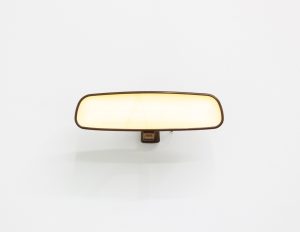
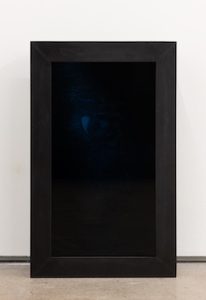
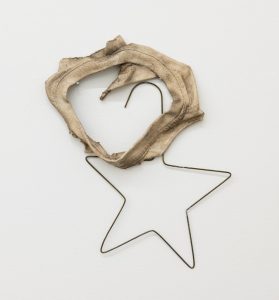
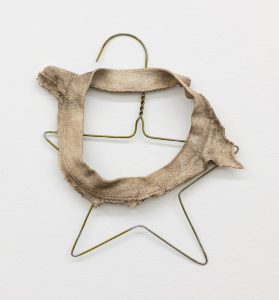
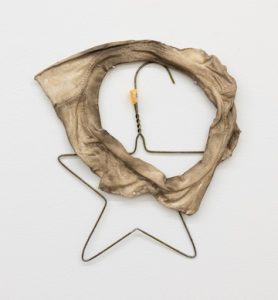
The exhibition is titled after a sculpture by Peggy Chiang, in which patinated steel, tempered glass, and automotive window tint veil an interior form’s arrival. Across her practice, familiar objects are reassembled, severed, or shielded to warp what a viewer expects of them. In a series of cast shirt collars mounted on star-shaped clothing hangers, markers of labor and class are detached from the body and reorganized into suspended, disembodied forms. In Hard to Imagine, a sculptural “black box” incorporating light and image positions the viewer in relation to what cannot be fully seen, heightening their awareness of looking. While functions may be displaced or obscured, use is still implied. Drawing on a visual language tied to authority, masculinity, and expansion, Chiang’s works subtly unsettle these associations—forms float, balance, tip, and disappear, and meaning remains just out of reach.
In similar fashion, Marina Grize’s approach to the photograph severs the context in which the figures and objects of her works are enclosed, thereby rendering them free. In the works on view, images are scanned from early issues (1984–89) of the lesbian erotic magazine On Our Backs and rendered as silver gelatin contact prints encased in cast aluminum frames. The photographs that once appeared across the pages of the magazine are cropped, distorted, and withheld, present and distant at once, enrapt in their absent activities. Rather than a portrait, a kind of free associative fiction takes place, where the mysteries of the photograph’s context and origin reveal an interior condition, something felt rather than something seen.
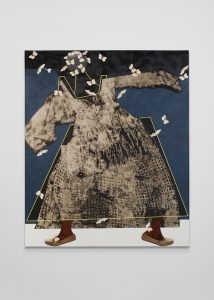
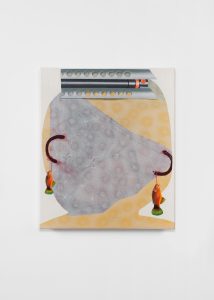
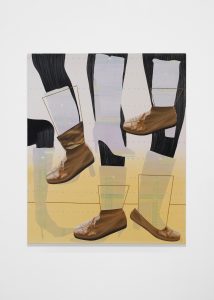
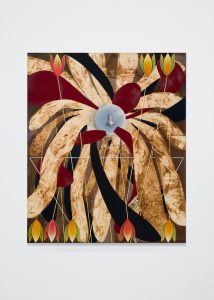
Veronika Pausova equally plays with absence. Her paintings come together through repetition and a buildup of surface constructed from negative spaces. In the works on view, fragments of clothing and personal objects act as stand ins for the body. In Dancing Moon, a printed dress unfolds into a figure crowned with a moon shaped head, while in Sprinkler Head, a face emerges from the impression of underwear and is topped with a sprinkler that never quite releases what it promises. Familiar objects shift between prop, costume, and surrogate body. Moments of clarity give way to open fields of color or obscured patterns, allowing the mind to move between what is seen and what must be imagined.
Peripheral vision is notably stronger than our direct lines of sight. An object of our desire, just out of reach, is often more present to us than what we already have. The clarity that enchantment provides, through the devotion it evokes within us towards that which we cannot see, becomes a powerful tool across all three artists’ practices. The contexts of our being are rarely up to our choosing, but how we allow being to be accessed can be. Hard to Imagine plays with these ideas of incoherence. Through a refusal to pour oneself on the page, the artists preserve a kind of internal life: a private domain where possibility runs freely through the fantasy we must only believe is there.
—Emily Small